Showing posts with label LAND. Show all posts

Friday, February 17, 2012

Harangan Situan Habonaran (Tombak Sulusulu)

Harangan Situan Habonaran or Tombak Sulusulu (Image, 2006)


Harangan Situan Habonaran or Tombak Sulusulu is the sacred places of Bakara’s history. In this Tombak Sulusulu  mother of the First Sisingamangaraja prayed a request to Ompu Mulajadi Na Bolon to get a son,and granted. In this place he went on to his son who became King in the Land of Batak,"King Sisingamangaraja." Harangan or tombak means forest, Situan Habonaran means place of the truth and sulu-sulu means torch lights.

Small forest on the rocky hill country rock at Bakara is overgrown ith various species of plants shrubs and trees, one of which Hau Sangkam Madeha, the biggest three there. There was Aek Manuruk (small well) but is now dry. 

In the midst of this forest there is a stone cave formed from boulders gap. This cave is where the place of King Sisingamangaraja to pray (martonggo/prayer request).

In one of tonggo  (prayer) King Sisingamangaraja, Tombak Sulu-sulu stated:
“Adian ni Batara Guru, Parmanuk-manuk Patia Raja
Parsombaon harangan sulu-sulu, paraek na manuruk,
Sulu-sulu ni Debata, sulu-sulu ni sombaon
Si sulu ni hata na pintor, si sulu ni hata na geduk.

Means, Tombak Sulu-sulu is the place of rest Batara Guru (the God), as the owner of Heaven Bird, name Patia Raja (Hulambu Jati Bird); sacred place the holiness of Sulu-sulu forest, where the water dived; the truth of Gods and the holiness, the giver of wise words and the truth.

It may be also Spear Sulusulu is nowhere mentioned by William Marsden, in his History of Sumatra (1811), about the location of the first man fall to the earth, the daughter ofGuru, named Puti Orla Bulan, in the Bakara:
“…Batara Guru, had a daughter named Puti-Orla-Bulan, who requested permission to descend to these lower regions, and accordingly came down on a white owl, accompanied by a dog; but not being able, by reason of the waters, to continue there, her father let fall from heaven a lofty mountain, named Bakarra, now situated in the Batta country, as a dwelling for his child; and from this mountain all other land gradually proceeded.”


Saturday, April 23, 2011

Parik and Harbangan Ni Huta

Parik & Harabangan ni Huta
in Lumban Raja, Land of Bakara (Image, 2006)

Characteristic of each huta (village) in Batak Land in ancient times was surrounded by a wall of earth or stone on top of it planted with thorny bamboo tree which grows tight. This wall is called  "parik ni huta" (fortress of the village), serves as a fortress to protect the village settlement area against possible enemy attack on the outside and from exposure to strong winds and attacks "evil mystical"

There is only one entrance and exit huta, a narrow gap that can only be passed by oneperson as the gate called "harbangan ni huta" (gate of the fortress). To pass, each person had to queue in front harbangan

Thursday, April 14, 2011

Tao Toba


Tao Toba at the side of Land of Bakara (Image, 2011)

Tao Toba (Tao=Lake, Toba=Toba), located in the middle of the island of Sumatra, is the largest and deepest lake in the world. The extent of approximately 1.707 m2 with a depth of 450 m and even in some places reaches 900m. Tao Toba is formed by volcanic eruption on hundreds thousands years ago. The lake is a huge caldera flooded by water. The source of water Tao Toba are river water discharge comes from the hundreds of rivers and streams and mountain springs located along the river flow.

Toba Batak tribes inhabit the highland areas of rocky mountains of the Bukit Barisan and most live in the valleys around the edge of Lake Toba that has many waterfalls, overgrown with various kinds of plants, mountain steppes. Air Temperatures in this region ranges from 17-29 degrees Celsius.

In the middle of Lake Toba, there are some islands such as: Samosir, Sibandang, Tolping, Maulau, Simamora, Toba and Tulas (island in the middle of the island of Sumatra). The biggest is Samosir Island with an area of 630 km2. In the middle of the island of Samosir there is also a lake, namely Lake Sidohoni. 

Samosir Island before it was made ​​canal in the Tano Ponggol (land severed) by the Dutch in the early 1900s, is not an island but a peninsula connected to the mainland island of Sumatra.

Monday, April 11, 2011

Royal Palace (Ruma Bolon)

Ruma Bolon (2006)

Lumban Raja  is huta (villages) located in the Land of Bakara, as government center of Sisingamangaraja Kings (I - XII) since the 16th century until 1907.


Royal Palace (Ruma Bolon) that appear now in the same location is a replica of the original that burned by Dutch colonial army in 1883.  The position of the palace on the slopes of the mountain overlooking the Tao Toba in Irisanna (East Sea).

Saturday, March 12, 2011

The Name of "Bakara" Meaning


Bakara means “a shady place of peaceful residence”. This land of Bakara was named by a king named Raja Oloan, as the founder. Bakara then given as the name of his first son (from his second wife Siboru Pasaribu).  Bakara become a clan, known as “marga” is carried by his descendants. In Batak society, “marga” is a family name of a single ancestral lineage, and form a group of people who inhabit a village.

This name of "Bakara" is derived from the word "bangka" and “ra” in  Batak Toba language.  Bangka (Batak Toba dialect pronounced as “bakka”) means the notch in the wood, and “ra” means going to/will. In traditional societies to be able to climb trees like coconut trees by making a notch on the stem. With the notch it will be easier to above the tree and not slipping.  “Bangka” also notch wood that funcioned as ladder  into Batak's traditional dwelling house (ladder = balatuk, in Batak language). As "bangka" and “ra” the anchestor founder of land hope this place as a stage to enter a better life.

Bakara also is derived from the word "bangkar" and "ra". Bangkar in Batak Toba language means that hard skin on the palm tree branches down and wrapped around the fibers. In the land Bakara first (now only a little) there are many palm trees. One part of the palm tree fibers used for the roof of the house. The function of the roof as to protect and shade from the weather.

From both origins can be traced to the meaning of the word is the philosophy of the ancestors who began life in the region that is the expectation that the land has become the place to start settlements and bred, and the ideal protection to achieve the welfare level of life. Therefore, Bakara is "a hoping land for peace and safety place for home residence."

Wednesday, December 8, 2010

The Legend of the Land

The legend of the land of Bakara began from a place in the heart of the village, named Tombak Sulusulu (Torch Forest). This forest also called Tombak Situan Habonaran, means a forest of place of holiness and the truthness.  This site known as:    
1. The legend of the first Batak's land formed, created by god's daughter Puti Orla Bulan as the mother's of  Batak origins.  
2. The place of mystical golden eagle bird, Manuk Hulambujati or Manuk Patiaraja as the god's messenger.
3. The place of  birth of the First King Sisingamangaraja as the "primus interparest" or "Priest King" of Batak Kingdom. 

Tuesday, December 7, 2010

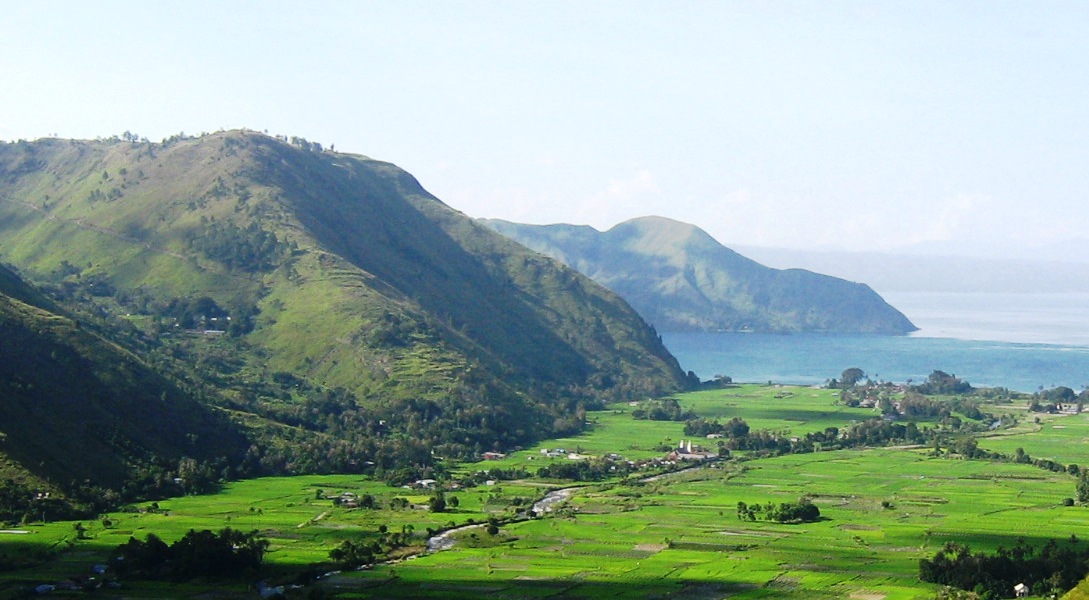
Land of Bakara

Land of Bakara (Image, 2010)
There is a small village, about 2.400 hectare wide, laid in the deep rural valley, surrounded by Bukit Barisan Mountain in North Sumatera, Indonesia. Located at the lake side of  Lake Toba in the South East, one of the biggest lake in the world. This land is rich of of spring water, waterfalls, and rivers.  A land of history, land of the Batak Toba ethnic, land of isolated traditions and culture, named Tano Bakara (Land of Bakara).


There are two big rivers flow through the land. First, the biggest one is Aek Silang, starts from waterfall Batubatu, in Desa Hutaraja. This river colour looks red, but the other river Aek Simangira looks white. Aek Simangira originates from two springs. The two rivers to be one river and flows 0.7 kilometres to the Lake Toba.

Bakara is the land of kingdom centre of Sisingamangaraja Kings (I-XI), the Batak's Kingdoms until 1907.